2025 at Laurelbank Farm
2025 has been the best year yet at Laurelbank Farm. Not the biggest. Not the most impressive-looking on paper. But the first year that has had hints of being genuinely sustainable — financially, emotionally, and physically.
I reread my end-of-2024 blog recently. A few people have since told me it’s a pretty bleak read. I remember thinking at the time that the final draft was much more cheerful than the first! I can still feel how exhausted I was when I wrote it. Not just tired, but brittle. On edge. Always struggling to make decisions. Running the farm felt like it would never be anything but almost impossible.
This winter feels different. I’m doing okay. And that’s a big deal. I have two 7-year-olds, and running a farm alongside being a parent is always a balancing act. It’s still a lot — but each year they get a bit older, a bit more independent, and things get a bit more possible.
This post is supposed to be a business review of 2025, but I’ve learned over the years that it’s impossible to separate my life from the business I run, own, and live in. So this is both a review of the farm and a review of the year I’ve had.
If you only look at the numbers, 2025 doesn’t look like a great year. Turnover is down again. In fact, if you look at the last five years, it might look like the business peaked in 2022 and has been in slow decline ever since.
But that would be completely the wrong conclusion.
2025 was the year I stopped trying to make the farm successful and started trying to make it actually work for me.
A Very Short Version of How We Got Here
I’ve been growing vegetables here for nine years. I’ve been running a limited company for five. And Laurelbank Farm, as it exists now, is two years old.
There was a partnership, a separation, and a company rename in the middle of that. From 2016 to 2023 the business was run with Erin, who is now my ex-wife and ex-business partner. In 2023 we separated, and after a lot of paperwork and emotional admin, the farm became fully mine. The company was renamed Laurelbank Farm Ltd (it used to be called The Edible Flower Ltd, for those who enjoy this sort of trivia).
The short version is: 2025 is the first full year where the farm has been shaped around one person’s capacity, energy, and priorities. That turns out to matter quite a lot.
The Last Five Years in Numbers (and Why They’re Misleading)
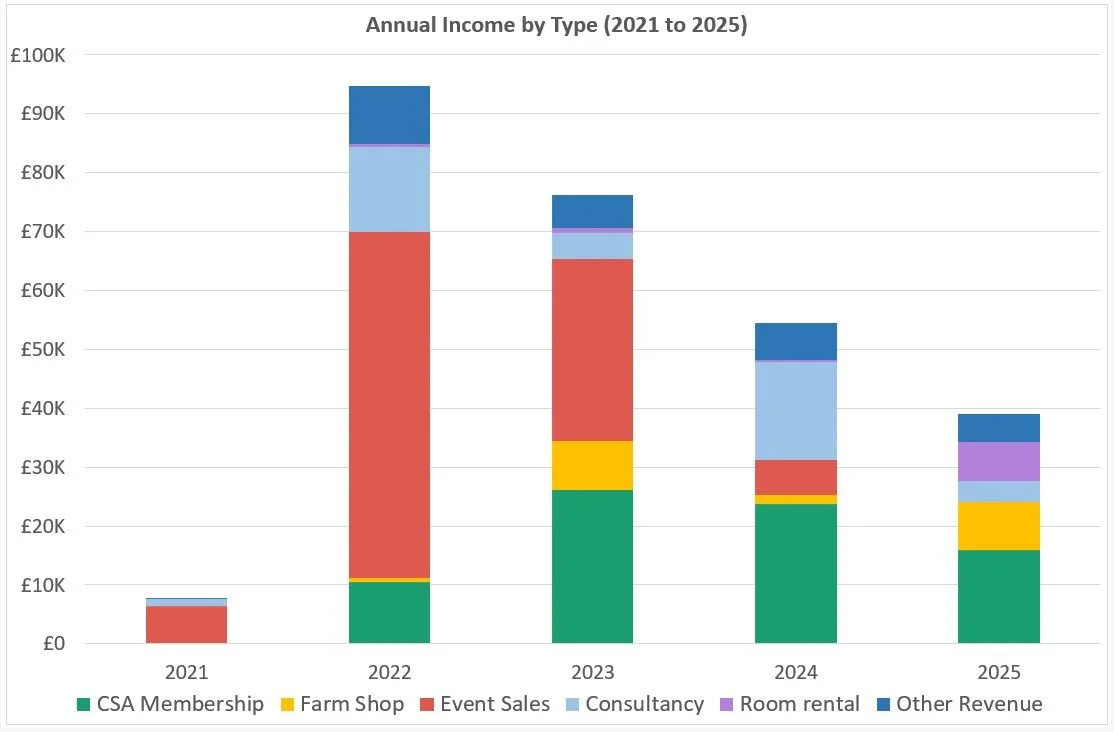
If you only look at turnover, this looks like a business in slow decline. 2022 was the biggest year, and it’s been dropping ever since. It would be easy to conclude that things have been getting worse.
But that would be completely the wrong conclusion.
A very quick review, year-by-year:
2021 was just a couple of months of trading after we set up the limited company, so the numbers are small.
2022 was the year of doing everything. We launched the event space, ran lots and lots of supper clubs (that big red bar), launched Farm & Feast (our CSA) and generally tried to make the farm do all the things at once.
2023 was a year of emotional chaos. Supper clubs tailed off as my marriage fell apart. By September Erin and I had signed a separation agreement and the farm became mine. At the same time, the CSA more than doubled in size (from about £10k to about £27k), and the book we’d written together was published, which shows up in “farm shop” income along with any ad-hoc veg sales.
2024 was the first year of Laurelbank Farm. The CSA stayed at a similar scale. I did a couple of supper clubs, a lot of teaching and workshops, and “Other income” includes the very first year of Growing Academy.
2025 shows another drop in overall farm turnover. But something more interesting is happening underneath. CSA income is down, but we launched a farm shop in spring — and if you combine CSA + shop, that figure is almost identical to 2024. There’s also a new purple block: room rental. I’ve started renting out the kitchen and event space rather than trying to run everything myself.
So yes — turnover is down. But so is stress, so is wasted effort, and so is time spent doing things that don’t really pay their way.
The Veg Problem
At the heart of Laurelbank Farm are our organically-certified vegetables. Growing beautiful, seasonal food in a way that improves the land rather than degrades it is what this place is really about.
The uncomfortable truth is: growing organic vegetables is quite easy (growing them organically is the easiest way I know how). Growing them and making a profit is really, really hard.
I hear this from other organic growers at all sorts of scales: many of them just about break even on the veg and only make real money on retail or hospitality. Given our scale (less than an acre of beds), our lack of machinery, and the undulating drumlins of County Down, I suspect we may never make a proper profit from vegetables alone.
And yet — I’m not going to stop.
Just because something isn’t profitable doesn’t mean it isn’t valuable. This farm creates a huge amount of value: in landscape, in soil, in learning, in community, and in my own quality of life. Some of that value is emotional and environmental. Some of it, slowly, I’m learning how to turn into income.
What Actually Changed in 2025
The real focus of 2025 was simple: make the farm (and my life) less stressful and more financially stable. That meant doing less of what loses money and more of what has a chance of working.
Here’s what that looked like in practice:
1) A year-round CSA, with help.
We moved from a 30-week CSA to a 50-week one. This was a huge change. It means we’re getting value from the farm all year instead of having a long, anxious winter gap. We also partnered with Beechlawn Organic Farm, who can grow staples like carrots and onions far more efficiently than we ever could. In the quiet months, we buy in from them and share those veg with our members. Members get great organic produce year-round; we get stability and far less shoulder-season anxiety!
2) We opened a farm shop.
Some crops are profitable (salad, herbs, tomatoes, strawberries). Some really aren’t (potatoes, onions, anything that takes ages to harvest by hand). The shop means we can grow more of the good stuff and stop forcing the farm to grow an “ideal CSA mix” at any cost.
3) We grew less.
In 2025 we deliberately reduced the number of beds in production. Less growing, less stress, less loss. If veg growing is going to lose money, I’d rather it lose a smaller amount.
4) We keep getting better.
Each year we improve: soil health, timing, success rates, efficiency. I’m still stubbornly determined to make this work one day. But I’m not going to beat myself up in the meantime.
I also need to say this clearly: none of this happens alone. I’m incredibly lucky to have a brilliant group of volunteers (thank you to Alan and Erin in particular!) and I genuinely couldn’t run this place without them. I also have an employee, Cat, and freelancer, Laura — both of whom have been patient, hardworking, and supportive while I slowly figure out how to make this all work better. This farm will always be a massive team effort.
Tapping Into the Value Beyond the Veg!
Earlier I said that growing vegetables might never really make money here — but that doesn’t mean it isn’t creating value. A lot of what this place produces is knowledge, confidence, and the experience of being on a working organic farm.
Growing Academy is the clearest expression of that.
Some people want a weekly veg box. Other people want to learn how to grow the veg themselves. In 2024 I ran one Growing Academy course for 12 people over 30 weeks. In 2025, I ran two — more than doubling the income and, if I’m honest, more than doubling the joy too.
The setting turns out to matter just as much as the content. Being here, week after week, watching the seasons change and learning by doing, is a big part of what people are actually paying for. A few of the students put it better than I ever could:
“Being on the farm, actually outside learning by doing, is the best way to learn.”
“Watching the farm change through the seasons was both educational and grounding.”
“Seeing organic growing happening in real life was so inspiring.”
“The setting is ideal — you learn while literally seeing it outside the classroom window.”
There’s a slightly boring accounting footnote here: in 2025 I ran Growing Academy outside Laurelbank Farm Ltd, as a self-employed person. It made life simpler for insurance, but it also had a big financial impact because it meant I didn’t have to charge VAT. The price of the course barely changed, but overnight it became about 20% more profitable. The graph above doesn’t show this income at all, which means 2025 is actually better than it looks.
But the bigger point is this: Growing Academy is one of the ways the farm’s “unprofitable” activity — growing veg — turns into something that very much is.
More Than a Farm
One of the slow realisations of 2025 is that Laurelbank isn’t just a place that grows vegetables. It’s also a beautiful, well-equipped, and surprisingly flexible space. We have a proper catering kitchen. An event space. A water tower converted into accessible toilets. A car park. And a setting that, despite my regular cursing of the drumlins when pushing wheelbarrows uphill, really is rather lovely.
I don’t have the energy to run lots of events myself anymore — but I do have the energy to let other people use the space.
In 2025 I started renting out the kitchen and event space more intentionally, and that’s what the new “room rental” line in the graph represents. It’s early days, but it already feels like a much better use of the assets we have here.
This was also the year we started Farm Therapy. Aisling (my wonderful lodger, who is a part-time GP and compassionate inquiry practitioner) ran the first sessions here with Public Health Agency funding. To keep a long story short: it was brilliant, and we’ll be doing it again. The farm was paid for hosting, feeding people, and providing the setting — another example of the place earning its keep without me having to exhaust myself in the process.
The common thread in all of this is simple: a place full of happy people is a joy to be around, and it helps quietly subsidise the much harder-to-monetise work of growing vegetables.
I should also add, towards the end of 2024 we set up a Community Interest Company. The long-term ambition is for more and more of what happens here to operate as a genuine social enterprise — and eventually for the whole farm itself to move in that direction. That ambition hasn’t gone away. Willow Club already runs through the CIC, and over time I hope more of the farm will too.
2025: The Year of Being (Usefully) Selfish
“Selfish: chiefly concerned with one’s own personal profit or pleasure.”
Yes. That sounds about right.
2025 was the year I started designing the farm around what I can actually sustain, rather than what looks good on paper or what I think I “should” be able to cope with.
That has meant making some slightly counter-intuitive business decisions — like growing less veg, not more. It has meant prioritising financial stability over ambition. It has meant leaving the farm regularly and forcing myself to have time off (helped enormously by the fact that my girlfriend lives down South!!).
It has also meant doing some things purely because I wanted to: starting a Willow Club, learning about eco-cleaning from the fabulous Mrs Rganics, hosting a farm event for Belfast Pride, and learning how to grow cut flowers. None of these were strictly necessary business moves. All of them made my life richer.
And it turns out that when my life is better, the farm works better too.
I’m not done with this. Looking after myself isn’t a one-year project. I intend to keep at it in 2026.
And 2026?
So what next?
This week we’re finalising crop plans, optimising bed layouts, and ordering thousands of organic seeds. I still need to sell the remaining places for Growing Academy (Monday evenings are full; there are still a few places on Tuesday mornings).
But I’m not going to work every hour of every day to write a grand masterplan for the future.
Instead, I’m going to finish what needs doing today, make some dinner, and relax.
If 2025 was the year I learned how to make this farm work without breaking myself, then 2026 will be about keeping it that way.